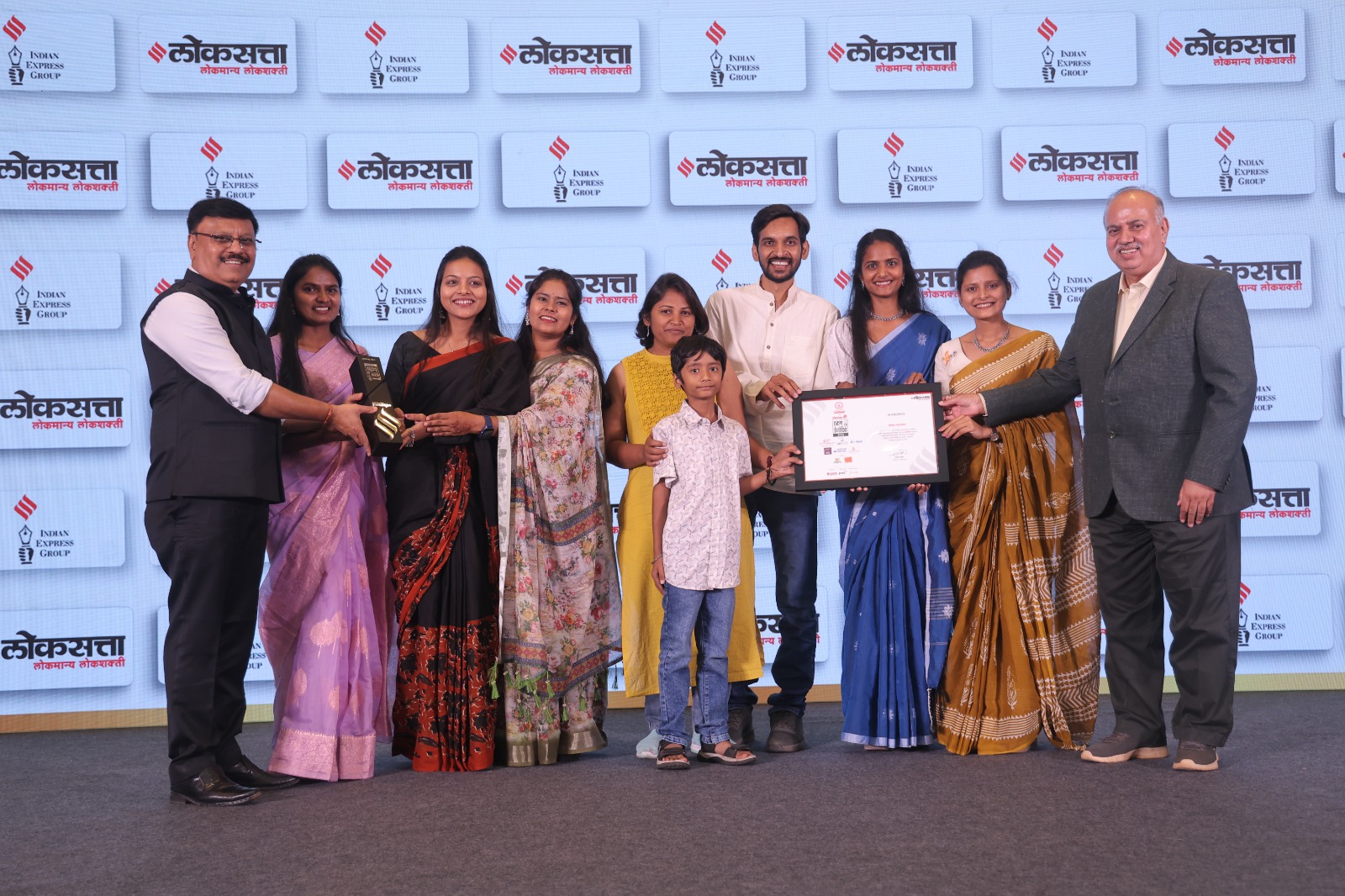
I was recently selected for the ‘Tarun Tejankit’ award in the social category by Loksatta (India Express group). To begin with, it feels deeply gratifying that a platform like Loksatta—which I have trusted since my school days as a symbol of good journalism—has taken note of our work. I’m sincerely grateful to the team for considering me worthy of this recognition.
That said, until very recently, at Learning Companions, we have been hesitant about accepting any awards. This came from a set of experiences, observations, and reflections about the idea of awards—the processes and the collective mindset around it. We felt that the downsides of the approach around and impact of the awards, as a social practice, outweigh their original purpose. Understanding these concerns—and finding ways to address them—felt more important to us.
Of all those reflections, I want to share just one here. It feels the most important, and I don’t want it to get lost in a long list. The rest we can explore as we move forward, as our time and interests allow us.
I remember a very specific moment. I was riding my bike to a school, mentally preparing for a session. I had one or two ideas to share with the teachers—ideas that I believed could make classrooms more engaging and accelerate children’s learning if implemented well. Just thinking about these possibilities filled me with excitement. I was also thinking about how to present them in a way that would spark the same excitement in the teachers. But then a question struck me—would the teachers feel the same excitement that I was feeling? And if not, why?
As I reflected, something became clear. If these ideas worked well, both the teacher and I would experience some joy, recognition, and appreciation. But the kind of recognition I would receive—the kind that was energising me—would not necessarily be the same for the teacher. If the rewards were not equally meaningful, how could we expect the same level of excitement or effort?
Today, as an organisation, we proudly share these outcomes: in the Bharwad community, where less than 10% of children could read, more than 70% of children across five settlements are now reading and learning further. We share that the local leadership we have nurtured is contributing to quality education across 20–25 organisations in the Vidarbha region. We speak about young people who stay committed to this work for two years despite extremely challenging conditions on the ground. Mostly which is why people appreciate our work. Which is why platforms like Loksatta took note of our work.
But behind every such outcome are countless quiet acts of courage. A mother from Bothli hamlet, Riddhi’s mother, despite already being under heavy burden of work, took on extra work so that her daughters would not have to drop out due to migration. She insisted they stay back with their grandparents so they could continue schooling.
Ajay, an 8–9-year-old from Sonkhamb, was so moved by small moments of appreciation from his teacher that he immersed himself in reading. In a place where a mere five years ago it was hard to find a child who could read simple Hindi, this young boy now reads and understands English so fluently, we ourselves wonder when did he learn so much.
Youth like Pratiksha and Rohini, who grew up in relatively secure urban environments, choose to live alone in villages where even finding a room is difficult and safety is uncertain—so that they could teach children with more regularity and time. And within two years, the village where not a single child could read saw literacy in school going children rise to 80%.
Divya’s mother (name changed) fights her own family and community to ensure her daughter continues her education instead of being married off early. Behind almost every child who continues learning, there is a story of resilience, stubborn hope, and quiet heroism. It is on the strength of all these stories that I can say with pride—we have been able to build something meaningful even in the face of immense challenges.
There is another side to this. Friendship. If I am doing the same work as Riddhi’s mother, Ajay, Pratiksha, or Rohini—but our emotional experiences of that work are different—then we may collaborate, but we won’t truly become friends. And for us at Learning Companions, friendship is the very purpose, the heart of our work. Because the way we see life, this work with the Bharwad community is not primarily about where children “reach” or whether they get jobs. At its core, it is about all of us—children, teachers, communities—coming together to create something joyful, meaningful, and adventurous. It is about living in the present moment.
We climb rugged mountains for the thrill of it. We don’t say, “How good it would have been if the road to the top was smoother and straight?” The uneven terrain is what makes the journey exciting. In the same way, “children not learning” or “fodder scarcity” are not just problems to eliminate. They are our playground. Experiencing the rush and the joy in how they challenge us, stretch our thinking, test our courage and patience; THIS is the primary driver of our work, above everything else. If, along the way, someone becomes better at math or starts earning more—that is a by-product.
Celebration and appreciation after crossing milestones are an essential part of this joy. And always together. At Learning Companions, during quarterly and annual reviews, we don’t give any individual awards like “Performer of the Year” or “Fellow of the Year.” Instead, we sit together. Each person gets a couple of minutes to share what they’ve done. Everyone listens—fully present. And later, when something resonates, we go up to that person and appreciate them. Over the last 5–6 years, we’ve seen that these spaces of expression are among the most loved—they bring the deepest satisfaction and excitement. Not once has any teammate asked why we don’t have “Best Performer” kind of awards at Learning Companions.
For us, there is no joy in doing anything alone—even going up to stage for receiving an award. The real joy is when our people stand beside us—not just in the audience, clapping—but on the stage, together, celebrating.
So when I learned about this award, my first instinct was to request Loksatta: could all of us be present there? Could we gather some funds, fill a bus, and travel together to Mumbai?
Yesterday, on March 31st, the ceremony took place. Yes, we met wonderful people. Our work reached more audiences. New possibilities for collaboration opened up. There was appreciation. But the most joyful part of it all was this—we experienced that moment together, as a group of 7–8 people.
The Loksatta team understood our sentiment. While we couldn’t bring the entire team, something important began. Devendra Gawande sir made sure our request reached the team. Even amidst the scale of the event, Girish Kuber sir remembered and acknowledged the team while presenting the award. That allowed me to share that moment on stage—not alone, but with my team.
We spent a couple of days together—attending the event, roaming around, talking, laughing, soaking in Mumbai as a group. That was our real award. And that is our true source of energy.We are deeply grateful to the Loksatta team for recognising this feeling and responding to a slightly unusual request. And through this, I also hope that we continue to find more ways—more human, more inclusive, more candid ways—to appreciate and encourage people. Also this is an invitation—to reflect on this, debate, or even act on it together.
This is a beautiful piece of reflection and insight, Dear Learning Companions. Wishing many more of such spaces and events that we can enjoy and celebrate together! May this togetherness award keep rewarding!