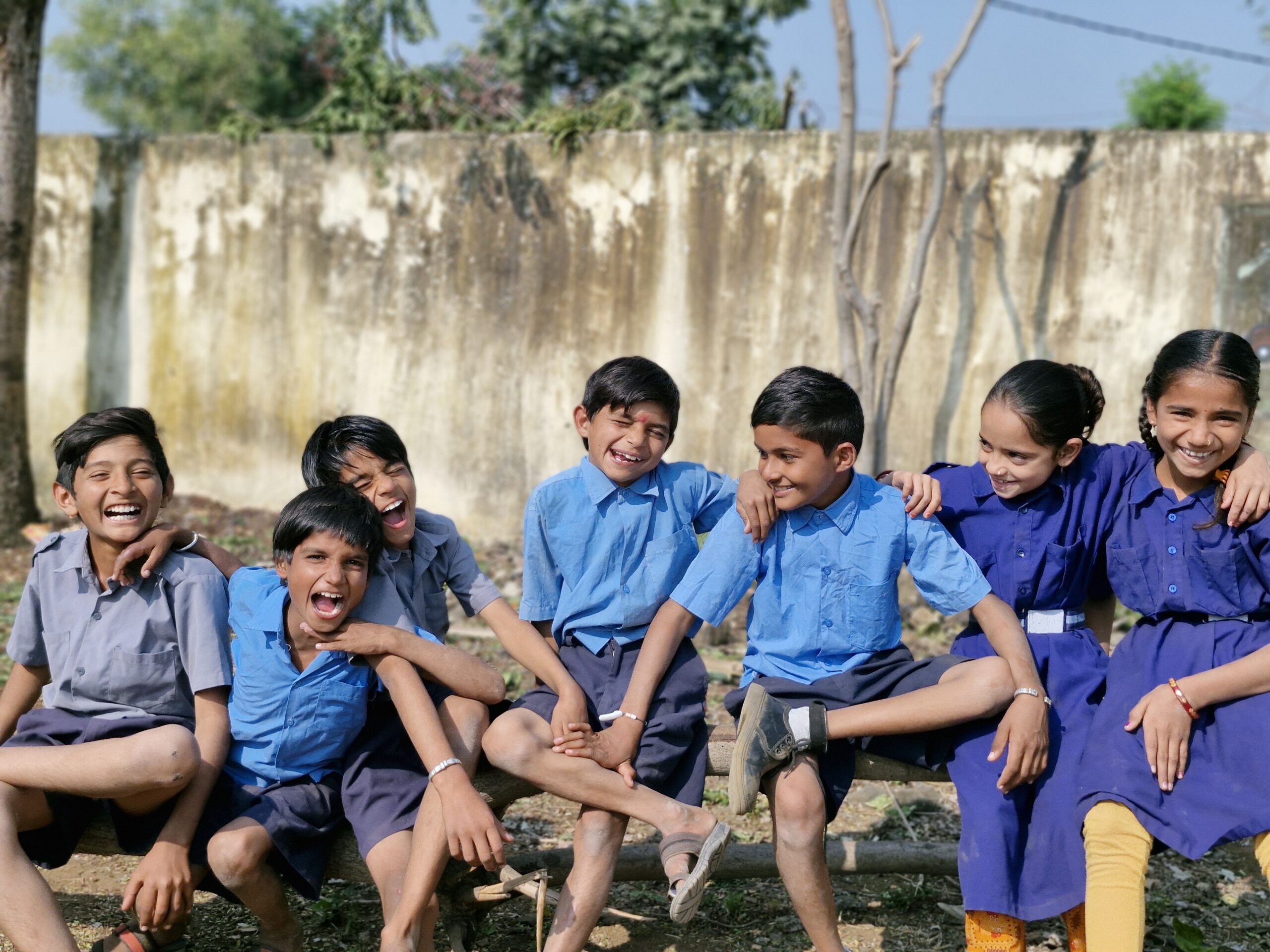

The Bharwad community is settled around Nagpur in small hamlets close to the forest areas, having migrated from Gujarat about five decades ago. They stay there for 4–6 months between June–November. But the grasses in the nearby areas get exhausted around Diwali, and they have to start moving in search of more fodder. The entire family wraps up everything and travels with the cows.
What the parents and teachers saw is that they have to migrate just as the children start learning a little something, and children miss school. Children forget things, lose rhythm, and they have to start everything again the next year. So the parents, teachers, as well as the children lost the motivation to go to school at all. They developed a mindset that — what is the point of trying to go to school even for these 4 months, if it is not producing any outcome?
When we at Learning Companions first began engaging with the Bharwad community in 2021, a few local teachers and parents shared this exact question with us.
How would you solve this?
First thing, in June 2022, we asked ourselves, “Is it necessary for children to attend school 16 years of their lives, 9–10 months a year, 5 days a week to be prepared for life?”
We realized that if children learn just two very strong things till grade four, we build a very strong foundation for everything else — Language and Mathematics. If you have excellent reading and listening comprehension, you can access knowledge of any subject by reading, watching, or listening on your own — you need no college or no teacher. Second, if you have strong foundations in Mathematics, every new learning is a problem-solving exercise; you can understand goals, think critically, experiment, and learn. You can learn all other subjects — history, science, geography, architecture — on your own, if you are prepared well with these two foundational skills.
This realization helped us in the most incredible way. Earlier, when children were in one place, we were trying to teach a little bit of language, a little bit of math, a little bit of science all at once. So, by the time children started migrating, they were not mastering any concept fully, and hence forgetting it all during the migration. Now, in June 2022, we said, we will care about only one thing — “Are our children learning to read?”
As a result, now we had 70% of the children who could read, and that learning was so strong, they didn’t just forget reading and start from zero when they came back from migration. Using that foundation in one language, this year our children are learning English, at an incredible pace. Apart from that, as children have a strong reading ability, many children have started taking admissions in high schools after 5th grade and excelling there. Children have started asking deeper questions about their life, community, present status, and possibilities as they are reading more books, watching movies, and meeting different people.
This was a turning point — we began to see that once children could read and think independently, they didn’t just learn lessons; they began learning from life itself.
Again, after 5th grade till the 10th, we believe children need two things. First, discover as many ways they can experience joy or earn a livelihood. Second, if they start liking something, they have enough opportunities to develop their skill in it, find a stage/opportunities for their skills, and be appreciated for that. At this stage, children are more independent, both with age and with the Language and Mathematics foundations which we talked about earlier.
For this age group, we conduct a lot of exposure visits, exposure through an abundant reading culture and movies during their settled period. And then we run some theme-based, week-long, residential workshops, which children can attend according to their interests. These workshops are called “Riyazghar” — flexible learning spaces designed for children from nomadic communities to explore interests, build skills, and connect their learning with real life.
So, for example, we will conduct a ‘Dress design and sewing workshop’ for a group of girls who want to learn sewing. They will be introduced to some core practices in this workshop, combined with some follow-up activities that will help them build the skill strong. Some themes would have multiple rounds of workshops based on the scope of the subject. So the children need not be in the school for the entire year, and they can continue learning without being forced out of their ways of living.
With this approach between 5th to 10th grade, we see our children pursuing their lives in three directions. One, many of these children will go into their own traditional, already existing profession, but only with better education, skills, self-awareness, and values. Second, one of our children, Kanha, discovered the idea of becoming a veterinarian doctor during one of the exposure visits. So the children like him can still give the 10th exam, because of the strong Language and Mathematics foundations, through an open schooling platform and pursue a typical career. Third, they will see other ways different people are pursuing careers with or without institutional training and create a similar path for themselves.
We are slowly seeing that this can be possible. Kanha is a 13-year-old boy from Thanthan center. He was about 9 years old when we first started our school in Thanthan, never having been to a school. Kanha learned to read and developed a love for reading during 2–3 small streaks between July 2022 to December 2023, missing the school for most days in between due to migration and household responsibilities.
In summer 2024, he got to attend a 2-month-long Riyazghar workshop, where he was exposed to a varied range of activities in Nagpur. He returned from a Riyazghar exposure visit declaring he wanted to be a veterinarian, a career deeply connected to his community’s pastoral life yet previously never in their imagination.
He missed school again between the months of November 2024–May 2025 due to migration and household responsibilities. This June, many of his peers from the community got admitted into some other high school as the parents realized that children are learning and they should start sending them to a school regularly. Kanha wasn’t sent with them due to household responsibilities. However, as we began the focus of learning English at our community center, Kanha picked up immediately. Building on his foundation in the first language, he is able to build competence in English at an impressive pace. He is doing so well that his English is improving much faster than the other peers who are attending a regular school.
Kanha is in continuous contact with us. We are not sure if two years later he will still want to be a veterinarian or he would start liking something else. But if he wants to pursue something that will need getting into a college, we will be creating support to help him clear the 10th exam successfully. With good foundations in Language and Mathematics, he should be able to clear 10th from an open schooling platform.
Kanha’s story, like many others, is still unfolding — but it shows what becomes possible when education adapts to life, instead of asking life to adapt to education.
Today this story has more theory elements than practical proofs; today, support available to Kanha is much less strong and structured than we would like, his Language and Mathematics foundations may not be as strong as necessary. But these stories in the last 2–3 years are showing real hope, against a conventional model which has kept nomadic children away from education for generations.
And most importantly, the Bharwad parents themselves have begun to believe that their children can learn and grow without abandoning their traditional life. Our model, practices, ideas, and people are also maturing and becoming stronger with every passing day. So, we have a real possibility — and we want to give it our all.